Accelerate Your Decision Making. Automate Your Lending Process.
Ensure the best outcomes based on your needs. Our rule engine as a service, which helps the loan origination system, configures all the business rules and credit parameters based on your credit policy. With a flexible and easy-to-use credit risk engine, we help empower your business, accelerate decision-making, and automate your lending process.
CloudBankin’s rule engine software is configured with the rules that make the credit policy. Data of the borrowers obtained from sources like Aadhar, PAN, CKYC, Credit Bureau, Bank statement Analyser, Alternate data, etc., are used as data points in the rule engine. The rules associated with these parameters are easily configurable. We have configured 2000 data points and can add more based on your requirements. Manual intervention can be minimised to the extent of taking informed final decisions when necessitated. Get the Credit Assessment Memo as the output.
Set your parameters easily, let our decision engine evaluate your borrowers and make credit decisions within minutes based on the outcomes with our inbuilt analytics!
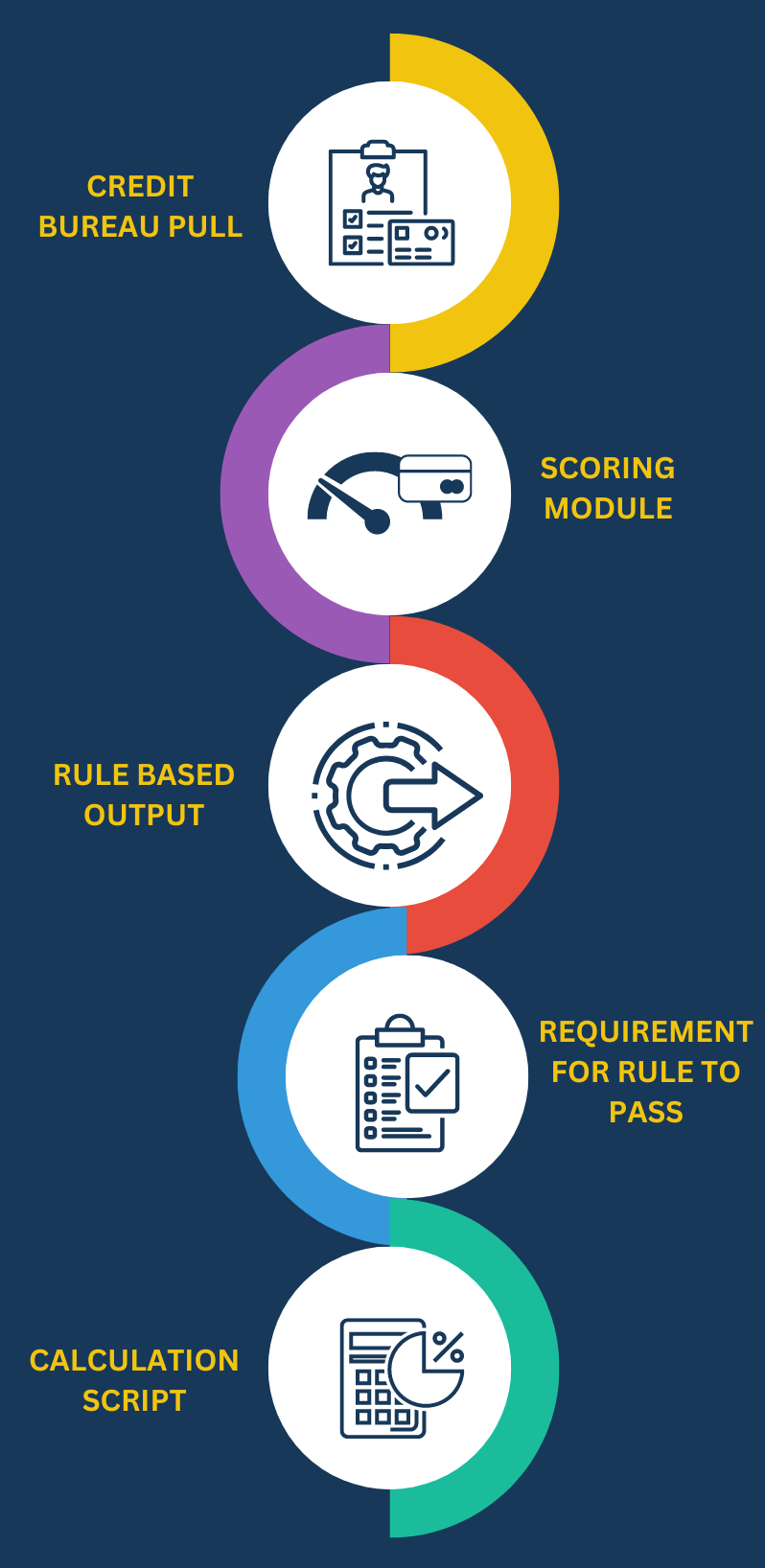
This module in our rule engine software is set up based on your credit rules that check for the eligibility criteria for the borrowers. Two types are integrated here:
Soft Credit Pull
A preliminary credit check appears on a credit report just like any other inquiry. Whether your borrower checks his own credit report or you are periodically reviewing his current credit accounts, a soft check is conducted. The soft inquiry doesn’t affect the credit score and can happen even if your borrower hasn’t applied for credit.
Hard Credit Pull
Your borrower gives you consent to check his credit report, which you need for the final decisioning. This is when a hard check occurs. This might even affect the borrower’s credit score.
2. Scoring Module
You can configure a basic score for each condition in the rule engine. The system will automatically create the borrower’s scorecard. For example, if your credit score is higher than 600, you should give a score of 10; if it’s higher than 650, you should give a score of 12. In this way, set scores for each condition and then produce a scorecard for the borrower.
3. Rule-Based Output
Our rule engine software will provide you with the results so you can make a credit decision after evaluating and processing your borrower’s loan against different conditions like age, credit score, borrower’s current salary, any prior loans of the borrowers, interest rates, and 100+ parameters. For instance, If a credit score is greater than 600, the interest rate is set at 12%, and if it is lower than 600, the interest rate is raised to 15%.
4. Requirement for Rule to Pass
We will be able to specify fundamental eligibility requirements in our rule engine, on the basis of which it will choose whether to accept or reject the borrower. For example, the minimum age requirement is 18. If the borrower is over 18, the application will be accepted; if they are under 18, the application will be rejected.
5. Calculation Script
Set up and manage your calculations based on various parameters of the rule engine platform. For example, we calculate Debt-to-Income Ratio and other financial ratios without touching the code.
Our Rule Engine Processes
Our credit risk engine software supports two processes. Whichever you need, we have it.
Straight Through Process
This involves complete automation where you directly view your borrower’s eligibility result with a loan offer after processing.
Underwriter Process
Here, our risk engine software shows borrower’s eligibility outcome to the underwriter after processing. Underwriters can verify and manually choose to give loan offers corroborating the engine’s result.
Ready to explore our business rule engine?
Get the best business results with our automated, flexible, customizable decision-making software!
After smartphone penetration, people are not watching their SMS at all. They use SMS only for OTP related transactions. That’s it.
But What can a Lender see in your SMS after you consent to them?
Lender can see income, expenses, and any other Fixed Obligation like (EMIs/Credit Card).
1) Income – Parameters like Average Salary Credited, Stable Monthly inflows like Rent
3) Fixed Obligations – Loan payments have been made for the past few months, Credit card transactions.
It also tells the Lender the adverse incidents like
1) Missed Loan payments
2) Cheque bounces
3) Missed Bill Payments like EB, LPG gas bills.
4) POS transaction declines due to insufficient funds.
A massive chunk of data is available in our SMS (more than 700 data points), which helps Lender to make a credit decision.
An interesting insight on vehicle loans for lenders.
A trend we are seeing today – the first-hand vehicle ownership is decreasing with time. Why? People are upgrading their vehicles in every few years because of technological advances. And, this can be seen more with the millennial generation.
So, what should a lender do in terms of financing?
– Estimating the residual value of the vehicle at the start of the financing period.
– Charging a borrower only for the residual value (which is the difference between the value after a few years and the current value)
Example: A bike currently is INR 1 lakh. You want to buy the vehicle for 2 years. A lender will estimate the residual value of that bike today and what it would be after 2 years. If the estimated residual value = INR 45,000, the lender will charge you only that (say, INR 55,000 with interest for this instance) during your tenure.
At the end of 2-year period, you have 3 choices:
1. Return the bike and upgrade to a new one without going through the struggle of selling it.
2. Pay the lump sum remaining amount to own the vehicle outright.
3. Extend the financing and own it by keep paying the EMIs for the remaining amount of the vehicle for the next 12 or 18 months.
Benefits for the borrowers?
– Flexibility to use a vehicle and upgrade to a new one.
– Affordability to not pay for the complete value of the vehicle with the intention to use for a lesser amount of time.
– Convenience in owning the vehicle.
Say goodbye to the old lending option and embrace the new way of financing for vehicle by lenders!
1) Tiktok does Lending ( is it an entertainment company or social media company or a fintech company?
2) Youtube China does Lending
3) Top 100 internet companies in China(no matter what business they are in) do Lending
The team which was heading Lending in Tiktok was the Advertisement team. If we do Ads, we do X no of revenue. But if we do lending, we’ll get X+30% more revenue. This is on the same Ad spot.
Ad team has transformed into a lending team, and in today’s world, it’s possible because the subject matter expertise can be put in as an API and given to you.
Embedded Lending as a service is becoming popular in India too, and I am happy to be part of this ecosystem.
The answer is No. Only the top 10 crore people have access to many credit products in India. Almost all Banks focus on this market.
Once you go beyond that, the credit access rate has dropped significantly due to multiple factors.
1) Customers who are having low income(30-40K per month)
2) Not earning from an employer who belongs to Category A or B
3) Not from Tier 1 or 2 cities
NBFCs and Fintechs focus on the above segment, pushing another 10 crores of people.
But in India, 70 crores more people are formally or informally employed, which still needs to be tapped.






After smartphone penetration, people are not watching their SMS at all. They use SMS only for OTP related transactions. That’s it.
But What can a Lender see in your SMS after you consent to them?
Lender can see income, expenses, and any other Fixed Obligation like (EMIs/Credit Card).
1) Income – Parameters like Average Salary Credited, Stable Monthly inflows like Rent
2) Expenses – Average monthly debit card transactions, UPI Transactions, Monthly ATM Withdrawal Amount etc
3) Fixed Obligations – Loan payments have been made for the past few months, Credit card transactions.
It also tells the Lender the adverse incidents like
1) Missed Loan payments
2) Cheque bounces
3) Missed Bill Payments like EB, LPG gas bills.
4) POS transaction declines due to insufficient funds.
A massive chunk of data is available in our SMS (more than 700 data points), which helps Lender to make a credit decision.
#lendtech #fintech #manispeaksmoney